
Liquid inspection
APT Liquid 360
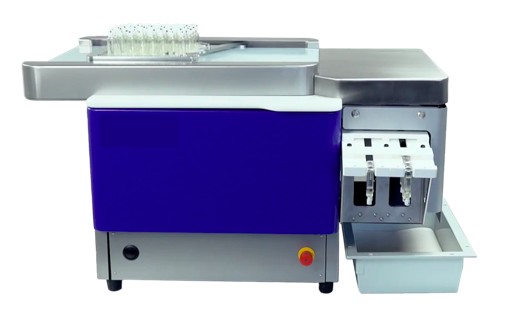
Inspect liquid-filled containers with controlled motion, machine vision and AI-assisted defect classification. APT Liquid 360 supports laboratory, clinical and smaller production batches through a modular architecture that can expand with inspection demand.
Application
Container agitation and rotation present the liquid and container surfaces for inspection. The system evaluates visible particles, cosmetic defects, fill level and closure appearance using an agreed product recipe and defect library. Container suitability and detectable defects are established through feasibility testing.
Key features
- Accept, Reject and Grey Zone classification with defect reason and severity.
- Recipes, electronic batch records, audit trails and controlled user access.
- Automated handling and accept/reject separation available in production configurations.
Technical information
| Feature | Specification |
|---|---|
| Container formats | Vials; syringes, cartridges and ampoules subject to feasibility and approved format parts. |
| Modular capacity | Up to 250 containers/hour per inspection module as a design target; application dependent. |
| Scaling | One, two or four inspection modules; four-module target up to 1,000 containers/hour. |
| Controls | Client PC connected by Ethernet with local web interface. |
| Configuration | Inspection modules, handling modules and data management combined to suit batch requirements. |
Optical checks of cracks and closure appearance do not by themselves establish container-closure integrity. Detection capability, acceptance criteria and qualification scope are defined for the application.
Proposed module envelope
| Feature | Specification |
|---|---|
| Inspection module | 410 × 265 × 550 mm, W × D × H; 60 kg. |
| Inspection electronics cabinet | 500 × 400 × 600 mm, W × D × H. |
| Handling module | 1,200 × 1,200 × 1,000 mm, W × D × H; 80 kg. |
| Handling electronics cabinet | 500 × 500 × 600 mm, W × D × H. |
| Buffer | Proposed combined infeed/outfeed buffer with positions for up to six nests. |
| Electrical supply | 100–240 V AC, 50–60 Hz, 16 A in the preliminary specification; confirm the final system load. |
| Operating environment | Proposed ambient range 15–25°C and 20–80% relative humidity. |
| Connectivity | Local operation through the client PC; network connection for data backup, updates and remote support as required. |
Module dimensions and utilities describe a preliminary project specification. Final installation details are established during engineering. Particles that remain hidden, stuck or optically invisible may not be detected; sensitivity, false rejects and throughput must be evaluated together.
System configuration, inspection capability and achievable output depend on the product, handling conditions and agreed application requirements. APT evaluates each application to define the appropriate inspection, integration and qualification scope.